
First problem: it doesn't fit
A cruising airliner flies about 10 km above the ground. The Moon is 3,474 km across, about a quarter of Earth's width. At a plane's altitude, it wouldn't be hovering overhead: it would be deep inside our planet. So the honest answer is that this scenario ends in the biggest collision imaginable.
But there's a more interesting question: what happens as the Moon gets closer on the way?
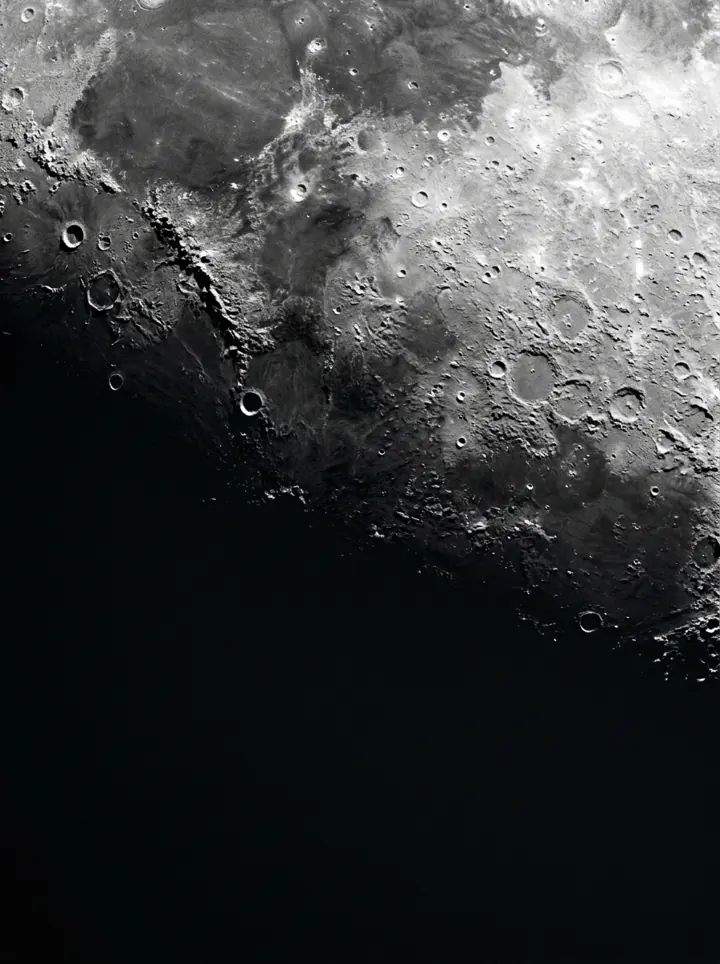
Step by step, closer
Today the Moon orbits an average of 384,400 km away. Let's move it in.
- 38,440 km: ten times wider. It would look about 5° across, roughly three fingers held at arm's length, instead of half a degree. Its orbit would shrink to about 21 hours (by Kepler's third law), so moonrise would come around almost every day.
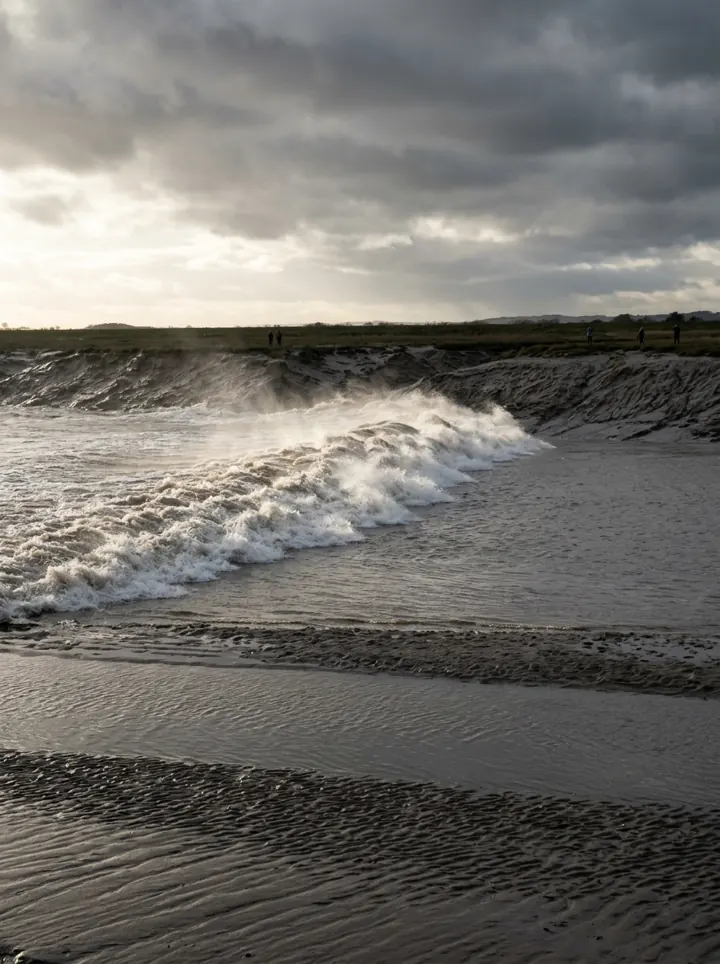
- Tides about 1,000× stronger. Tidal force depends on 1/distance³. The ocean's response would be measured in hundreds of metres, sweeping coastlines on every pass.
- The ground flexes. Solid rock has tides too. Constant flexing would heat the crust and likely fuel earthquakes and volcanism, like Io, Jupiter's volcanic moon heated by tides.
- The Roche limit. Closer than roughly 18,000 km, Earth's tidal pull on the near side of the Moon exceeds the Moon's own gravity holding it together. It would break apart into a ring of debris.
Why tides get so extreme
Tides happen because the Moon pulls harder on the side of Earth facing it than on the far side. That difference stretches the oceans. Since the difference shrinks with the cube of distance, small changes in distance make huge changes in tides: half the distance means 8× the tides; a tenth of the distance means 1,000×.
Places like the Qiantang River in China or the Bay of Fundy already show how dramatic tides can be with today's Moon. Multiply that by a thousand and no coastline would stay put.
A Moon torn into rings
Every moon has a distance it can't cross without being pulled apart: the Roche limit. For a fluid body with the Moon's density orbiting Earth, it's roughly 18,000 km. A solid, rigid Moon could hold together somewhat closer (around 9,500 km) before cracking. Past that point, Earth's pull would shred it into a ring like Saturn's. Over time, much of that debris would rain down, an impact barrage that would reshape Earth's surface.
The real Moon is leaving
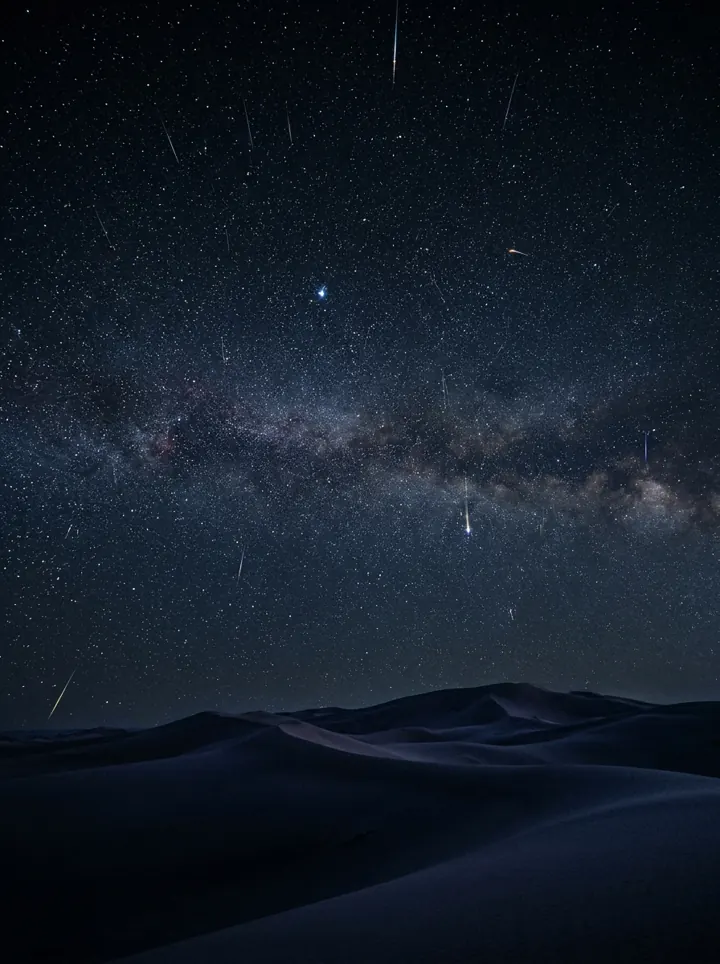
Here's the reassuring part. Laser measurements, made by bouncing light off reflectors left by the Apollo missions, show the Moon is moving away from us by about 3.8 cm every year. Billions of years ago it was much closer than today, and the tides really were stronger. We got to the calm version.
FAQ
How far away is the Moon?
On average about 384,400 km. It varies between roughly 363,000 and 406,000 km during its elliptical orbit.
What is the Roche limit?
The distance within which a planet's tidal forces would tear apart a moon held together only by its own gravity. For the Moon and Earth, it's roughly 9,500–18,000 km depending on how rigid the Moon is.
Is the Moon getting closer or further away?
Further away, by about 3.8 cm per year, measured with lasers bounced off reflectors left on the Moon by the Apollo missions.
Why would tides be 1,000 times stronger?
Tidal force scales with the inverse cube of distance, so bringing the Moon 10 times closer multiplies it by 10³ = 1,000.
Sources & further reading
- NASA: Moon Fact Sheet (mean distance 384,400 km, diameter 3,474.8 km).
- Dickey, J. O. et al. (1994). Lunar Laser Ranging: A Continuing Legacy of the Apollo Program. Science (Moon receding ~3.8 cm/yr).
- Roche limit: standard celestial mechanics, d ≈ 2.44 R (ρ_Earth/ρ_Moon)^(1/3) for a fluid satellite.
- Tidal force ∝ 1/r³ and Kepler's third law (T ∝ a^1.5): standard physics references.
- NASA: Io, Jupiter's tidally heated volcanic moon.
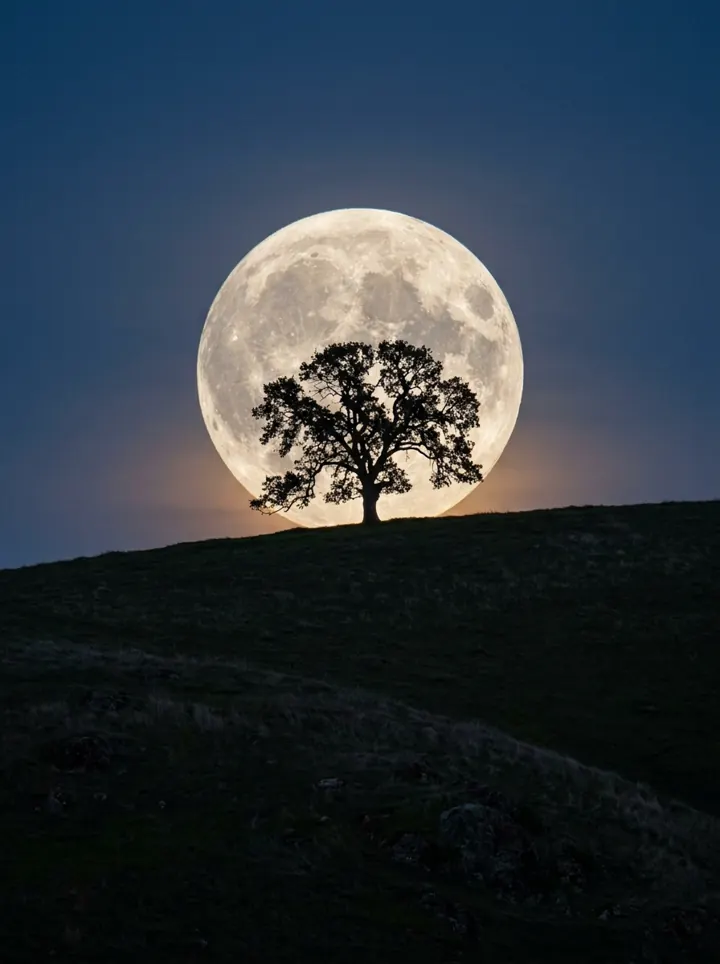
This is a hypothetical scenario explained with real science. Numbers are rounded for clarity. Images are AI-generated illustrations of real phenomena. Spotted an error? Tell us and we'll fix it.